
Shared Autonomy, Human–Robot Collaboration and Robotic Hands
Robots that work with people must understand what they intend and share control with them in a natural way. We decode muscle activity to control robotic hands and to teach collaborative robots, let the robot regulate grip strength in shared autonomy, map human hand motions onto anthropomorphic hands, and build wearable devices that assist the human arm.
Myoelectric Control of Robotic Hands
4 papers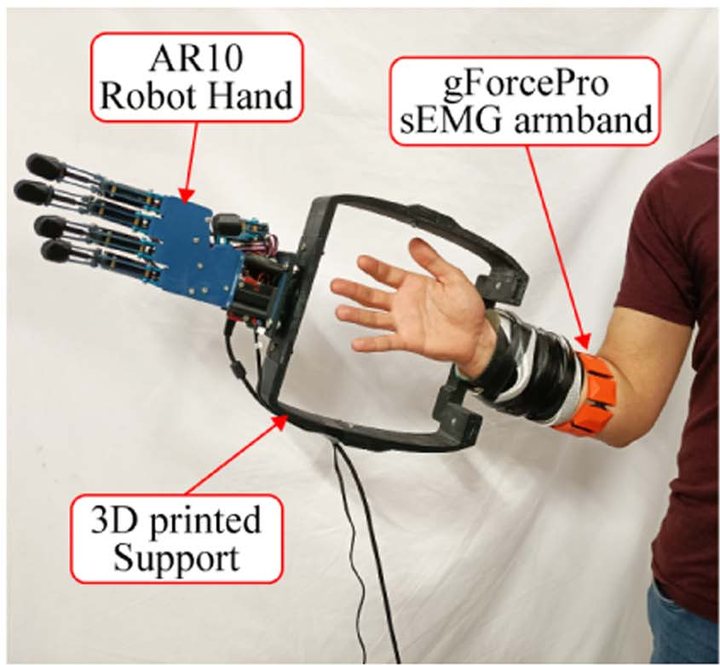
Surface electromyography (sEMG) measured on the forearm reveals how a person intends to grasp. We regress these signals into continuous commands for multi-fingered robotic hands while avoiding the tedious instant-by-instant labelling that supervised learning requires: non-negative matrix factorization combined with deep neural networks in a self-supervised scheme, minimally supervised networks trained with a soft-DTW loss, weakly supervised regression, and temporal convolutional networks that run on a low-power microcontroller.
Key papers
-
Self-Supervised Regression of sEMG Signals Combining Non-Negative Matrix Factorization With Deep Neural Networks for Robot Hand Multiple Grasping Motion Control
IEEE Robotics and Automation Letters, 2023
-
sEMG-Based Minimally Supervised Regression Using Soft-DTW Neural Networks for Robot Hand Grasping Control
IEEE Robotics and Automation Letters, 2022
More papers
-
sEMG-based Regression of Hand Kinematics with Temporal Convolutional Networks on a Low-Power Edge Microcontroller
2021 IEEE International Conference on Omni-Layer Intelligent Systems (COINS), 2021
Shared Autonomy and Grip-Strength Regulation
5 papers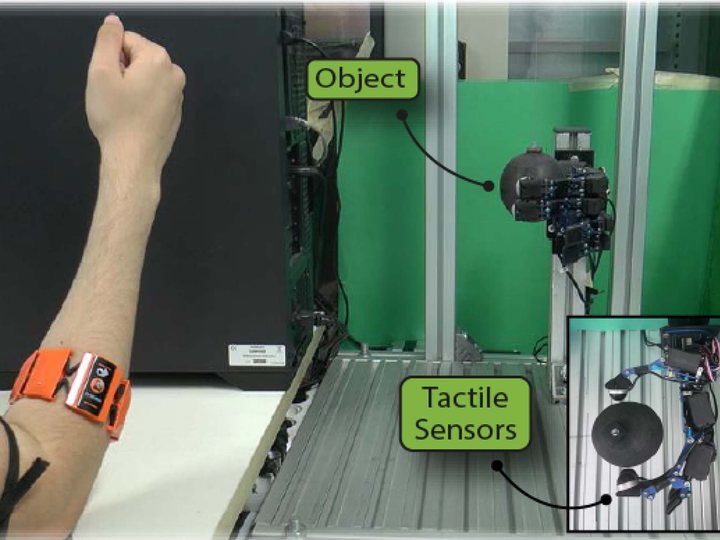
Holding an object firmly but gently is hard when the command is a noisy muscle signal and the user cannot feel the contact. In our shared-autonomy schemes the robot takes over part of the control: tactile sensors on the fingers close the force loop, vibrotactile feedback tells the user how strongly the hand is gripping, and hidden Markov models applied to tactile data split the grasp into phases that set how much autonomy the robot hand takes. Fuzzy force controllers are tuned to each user's preferences. The same idea supports teleoperated cable manipulation with visual aid, and we study EEG error-related potentials as a feedback channel from the user to the robot.
Key papers
-
Hidden Markov Model-Based Shared Autonomy for Grip Strength Regulation in sEMG Driven Robot Hand Control
IEEE Transactions on Robotics, 2026
More papers
-
User-Tailored Fuzzy-Based Grasp Strength Regulation in Myocontrolled Robotic Hands
2025 IEEE 30th International Conference on Emerging Technologies and Factory Automation (ETFA), 2025
-
A Control Architecture for Grasp Strength Regulation in Myocontrolled Robotic Hands Using Vibrotactile Feedback: Preliminary Results
2019 IEEE 16th International Conference on Rehabilitation Robotics (ICORR), 2019
-
A Vision-based Shared Autonomy Framework for Deformable Linear Objects Manipulation
2023 IEEE/ASME International Conference on Advanced Intelligent Mechatronics (AIM), 2023
-
Challenges in Detecting and Analyzing EEG Error-Related Potentials: Lessons from a Case Study in HRI
2024 33rd IEEE International Conference on Robot and Human Interactive Communication (ROMAN), 2024
Robot Teaching with Neuromuscular Interfaces
5 papers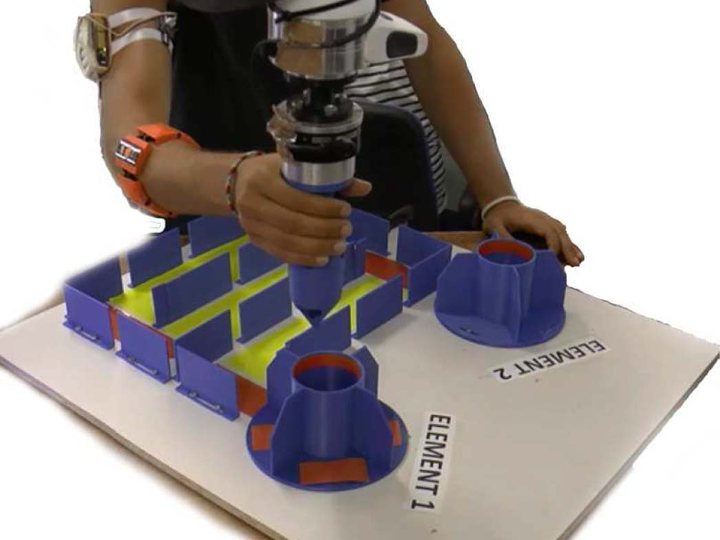
Kinesthetic teaching lets an operator program a collaborative robot by guiding it by hand, but it records only the path. We add a second channel: a wearable sEMG interface estimates how much the operator stiffens the hand (muscle co-contraction) without interfering with voluntary movements, and vibrotactile feedback makes this level perceivable. Stiffening the hand can request a more accurate trajectory, learned through constrained smoothing B-splines, or set the compliance of the robot point by point, in both kinesthetic and teleoperated programming by demonstration.
Key papers
-
Robot Programming by Demonstration: Trajectory Learning Enhanced by sEMG-Based User Hand Stiffness Estimation
IEEE Transactions on Robotics, 2023
-
Programming Robot Interaction Behavior During Kinesthetic Teaching Exploiting sEMG-Based Interfacing and Vibrotactile Feedback
IEEE/ASME Transactions on Mechatronics, 2025
-
Neuromuscular Interfacing for Advancing Kinesthetic and Teleoperated Programming by Demonstration of Collaborative Robots
IEEE Transactions on Haptics, 2024
More papers
-
Combining Unsupervised Muscle Co-Contraction Estimation With Bio-Feedback Allows Augmented Kinesthetic Teaching
IEEE Robotics and Automation Letters, 2021
Human-to-Robot Hand Mapping and Anthropomorphic Hands
6 papers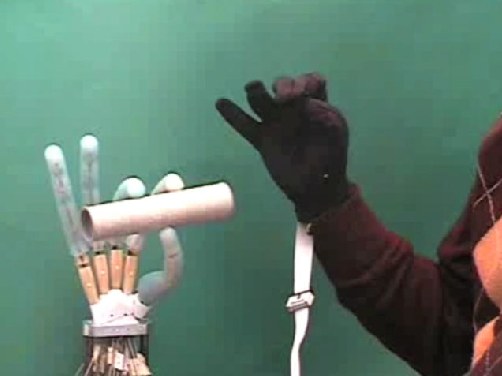
To teleoperate an anthropomorphic robotic hand, the motion of the operator's hand must be mapped onto a hand with different kinematics. We reviewed and classified the mapping methods proposed in the literature, and developed hybrid joint–Cartesian mappings that exploit in-hand spatial information to preserve both the finger shapes and the fingertip positions. This builds on the lab's experience with anthropomorphic hands, from the UB Hand to synergy-based control with fingertip force sensors and a compliant, low-cost prosthetic hand.
Key papers
-
Human to Robot Hand Motion Mapping Methods: Review and Classification
IEEE Transactions on Robotics, 2022
-
Exploiting In-Hand Knowledge in Hybrid Joint-Cartesian Mapping for Anthropomorphic Robotic Hands
IEEE Robotics and Automation Letters, 2021
More papers
-
Simulative Evaluation of a Joint-Cartesian Hybrid Motion Mapping for Robot Hands Based on Spatial In-Hand Information
Frontiers in Robotics and AI, 2022
-
Synergy-Based Control of Anthropomorphic Robotic Hands with Contact Force Sensors
IFAC-PapersOnLine, 2019
-
Conceptual Design and Virtual Prototyping of a Compliant, Low-Cost Prosthetic Hand
ASME 2023 Conference on Smart Materials, Adaptive Structures and Intelligent Systems, 2023
Assistive Wearable Devices and Safe Physical Interaction
5 papers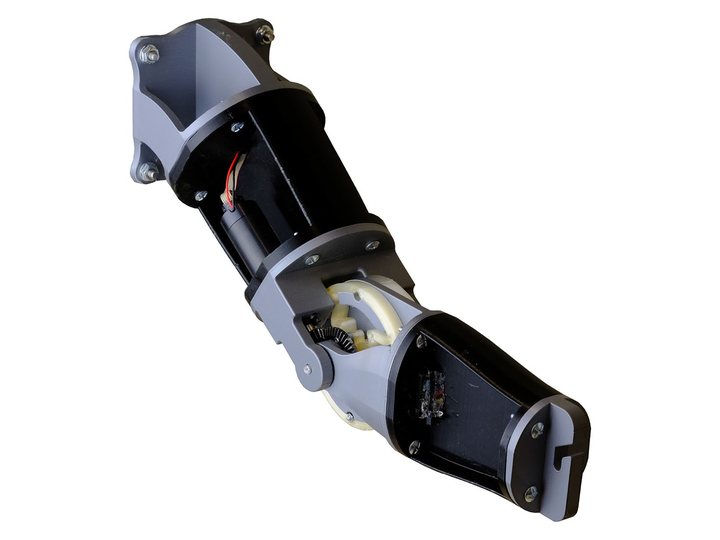
Muscle signals also drive devices that physically support the human body. We developed a lightweight soft exosuit actuated by twisted string actuators that assists the elbow in single- and dual-arm tasks, and human-in-the-loop controllers that let an assistive robot either compensate muscular effort or generate it for strength training. For safe physical interaction we designed variable-stiffness actuators, including an anthropomorphic elbow joint, and a twisted-string haptic interface for teleoperation with force feedback.
Key papers
-
A sEMG-Driven Soft ExoSuit Based on Twisted String Actuators for Elbow Assistive Applications
IEEE Robotics and Automation Letters, 2020
-
sEMG-Based Human-in-the-Loop Control of Elbow Assistive Robots for Physical Tasks and Muscle Strength Training
IEEE Robotics and Automation Letters, 2020
More papers
-
Design, modeling, and control of a variable stiffness elbow joint
The International Journal of Advanced Manufacturing Technology, 2022
-
Virtual and physical prototyping of a beam-based variable stiffness actuator for safe human-machine interaction
Robotics and Computer-Integrated Manufacturing, 2020
-
Towards a Twisted String Actuated Haptic Device: Experimental Testing of a 2-D Virtual Environment and Teleoperation Interface
2021 20th International Conference on Advanced Robotics (ICAR), 2021